![Dan Cvrcek [Tsvrcheck]](/blog/assets/images/bio-photo.jpg)


What Your Engineers Would Build With 6 Hours Back Per Week
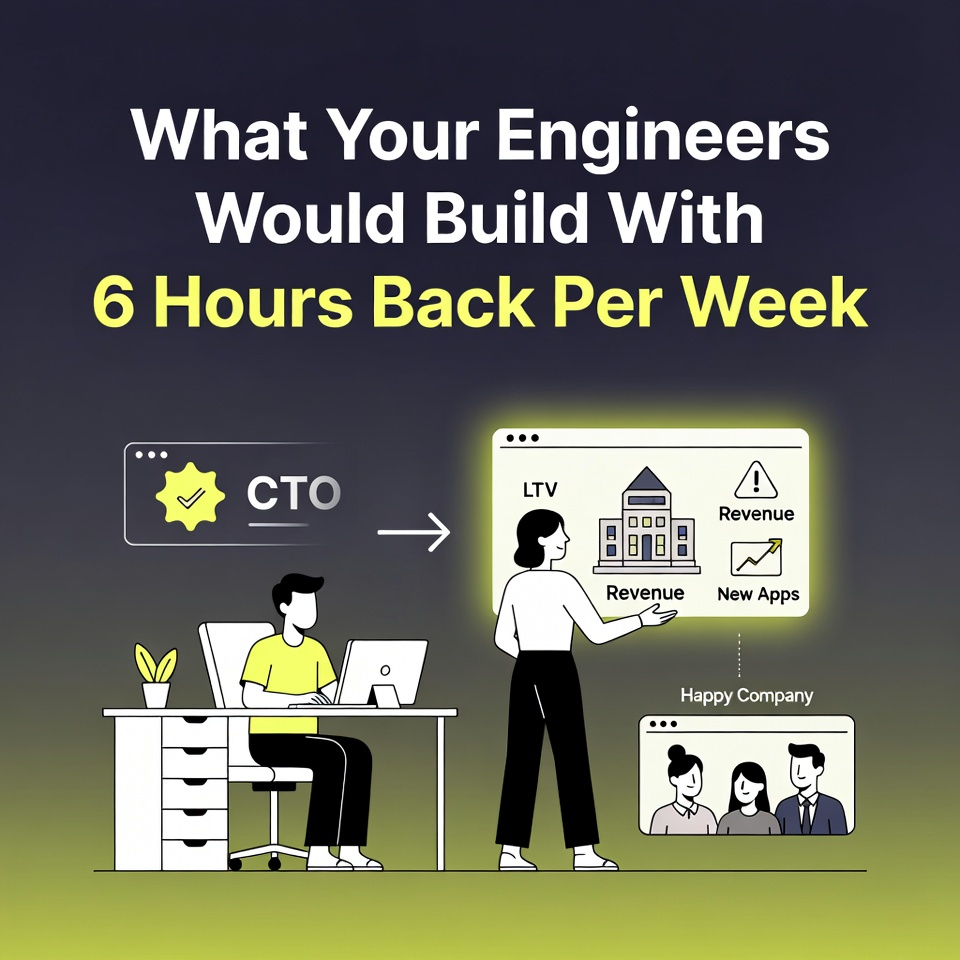 Recovered maker time isn’t just “more hours” — it’s the deep-focus time where your best engineers design the systems you wish you already had.
Your best engineers aren’t slow. They’re interrupted.
Somewhere between an API to register a new user and updating web UI, a certificate renewal lands in their Slack “can I borrow you for 5?”. It’s not hard work. It’s not interesting work. But it’s their work, because they’re the ones with production access, or they’re the ones who understand the dependency chain, or they’re simply the ones who answered when the alert fired.
12 minutes doing that, 23 minutes to re-focus and remember what line they were updating last. It’s now 20 mins till lunch time … they don’t find any point in getting into zone yet.
Nobody tracks it. Nobody reports it. And nobody asks the question that actually matters: what would they have built instead?
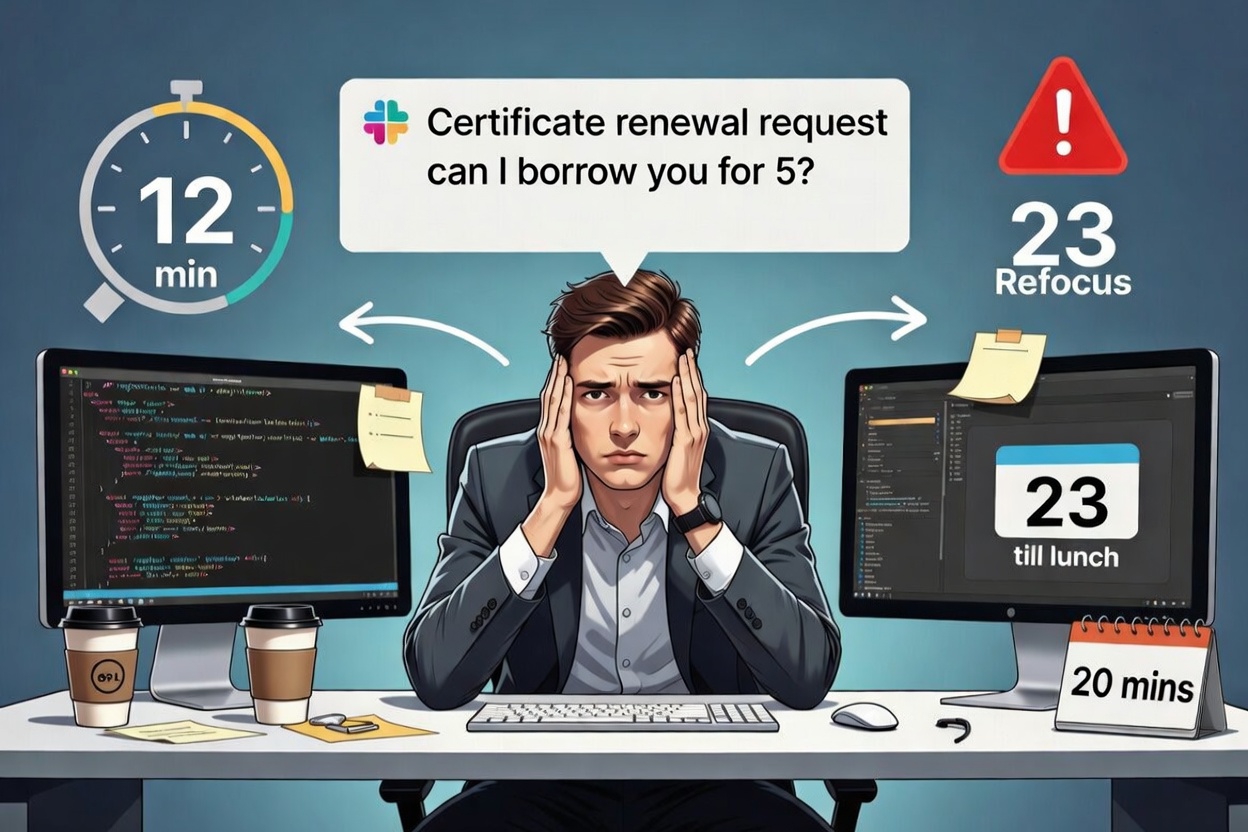 A “quick” certificate renewal looks like five minutes in Slack and quietly costs the whole afternoon of maker time.
The Maker’s Schedule vs. The Certificate’s Schedule
Paul Graham wrote about this twenty years ago in "Maker’s Schedule, Manager’s Schedule" (July 2009). Makers need long, unbroken stretches of time. A single meeting in the middle of an afternoon doesn’t cost you thirty minutes - it costs you the entire afternoon, because the work on either side of it never reaches depth.
Certificate renewals are just like that - if planned, they are like meetings, if unplanned, they cause bugs from unfinished thoughts. Either way, they destroy half of a productive day. And you may need three, five, even more touch points — for a single production certificate.
A certificate renewal alert, the approval queue, the production window - none of these take into account your engineering calendar or how your best engineers manage their time. None of them care that your platform team is mid-sprint on the migration that’s already three weeks behind.
Every touch point is an unscheduled interruption that resets the clock on deep work.
Your engineers don’t lose the 12 minutes it takes to handle the task. They lose the sixty to ninety minutes it takes to get back to where they would be with a clear calendar.
The Hours Nobody Counts
I’ve worked inside enough enterprises to know how this plays out in practice. Nobody has a line item for “time lost to certificate operations.” It doesn’t show up in capacity planning. It doesn’t exist - it’s a ghost time that creates an empty space where your build milestones should be.
A typical platform team supporting a few hundred certificates across mixed infrastructure will burn somewhere between four and eight engineering hours per week on certificate-related work. Not the team collectively—per engineer who gets pulled in.
That’s triage. Chasing approvals through change management. Coordinating with the app team who owns the service. Deploying to the endpoint that isn’t wired into automation. Verifying the renewal actually worked. Updating the spreadsheet that someone, somewhere, still relies on.
None of these tasks are difficult. All of them are disruptive.
And the worst part: your engineers know exactly what they’d love doing instead.
The Sprint That Keeps Slipping
Here’s the arithmetic that should make engineering leadership uncomfortable.
Take a team of eight platform engineers. Each one loses just two afternoons per month to certificate-related interruptions. That’s 64 engineering hours per month. Roughly two hundred hours per quarter.
Two hundred hours is a full engineering sprint. A real one. Not a planning exercise - actual build time.
Now ask yourself: what backlong Jira tickets keep getting bumped?
The Kubernetes migration that’s been “next quarter” for three quarters. The observability platform that would cut your mean-time-to-detection in half. The internal developer portal that would stop every new joiner spending their first week figuring out how to request infrastructure.
These aren’t hypothetical projects. They’re real priorities that lose the resource war every single sprint, because operational interrupt work—certificate renewals included—silently eats the time they need.
You’re not short on engineers. You’re short on focus time - uninterrupted builder time.
What Recovered Time Actually Looks Like
 When certificates just work, your engineers spend their time building systems—not babysitting renewals.
One recovered sprint per quarter means your platform team can take on one strategic project that currently sits in the “important but not urgent” pile. That’s the category where competitive advantage of your whole company lives and dies. Urgent are things that break and users need them. Important are things for the future - to get new customers, build new services, increase life-time value (LTV) and profitability.
Certificates that just work - for years - means your senior engineers spend afternoons in architecture work instead of babysitting renewal tickets. The people you’re paying $150k+ to think about system design are actually thinking about system design.
It means fewer categories of things that interrupt your builders. Certificate expiry drops off the list entirely. Engineers who aren’t context-switching between product work and ops tickets write better code — and your on-call rotation gets lighter because the fires that certs used to cause are gone. That compounds.
The Compound Effect
Here’s what most ROI calculations miss: recovered time doesn’t just add up. It compounds.
An engineer who gets a full, uninterrupted afternoon doesn’t produce twice the output of two scattered hours. They produce something qualitatively different. They reach the deep-focus state where architectures get designed properly, where edge cases get caught before production, where the solution that prevents ten future tickets gets built instead of the quick fix that creates three.
Certificate renewals don’t just steal time. They steal the kind of time where your best work happens.
Every interruption that disappears doesn’t just return the minutes. It gives back joy from building. I know what it’s like to see a new wall on a hoouse build that was not there in the morning. A great software gives similar pleasure. It’s what makes great engineers go an extra mile.
Want to find out how many engineering hours your team is losing? Try our calculator. The number will surprise you.