Keyfactor vs Venafi (CyberArk) vs DigiCert 2026: Real Pricing, TCO & Who Actually Wins for 10K–1M Certificates
Keyfactor vs Venafi (CyberArk) vs DigiCert 2026 full comparison: pricing tables, hybrid PKI support, ACME automation, migration effort and who actually wins for enterprise certificate management. This page gives an independent side-by-side so you can choose or replace a platform with confidence.
Written by Dan Cvrcek, AxelSpire — PKI Architect & Founder Led 15+ enterprise PKI migrations (Deutsche Bank, Sky/Comcast, TSB). Ex-Venafi and Keyfactor customer who now helps teams integrate PKI into enterprise inventory and process systems. Creator of 3AM Mint — a serverless AWS private CA in the 3AM product family.
Keyfactor vs Venafi (CyberArk) vs DigiCert: 2026 Enterprise PKI Comparison
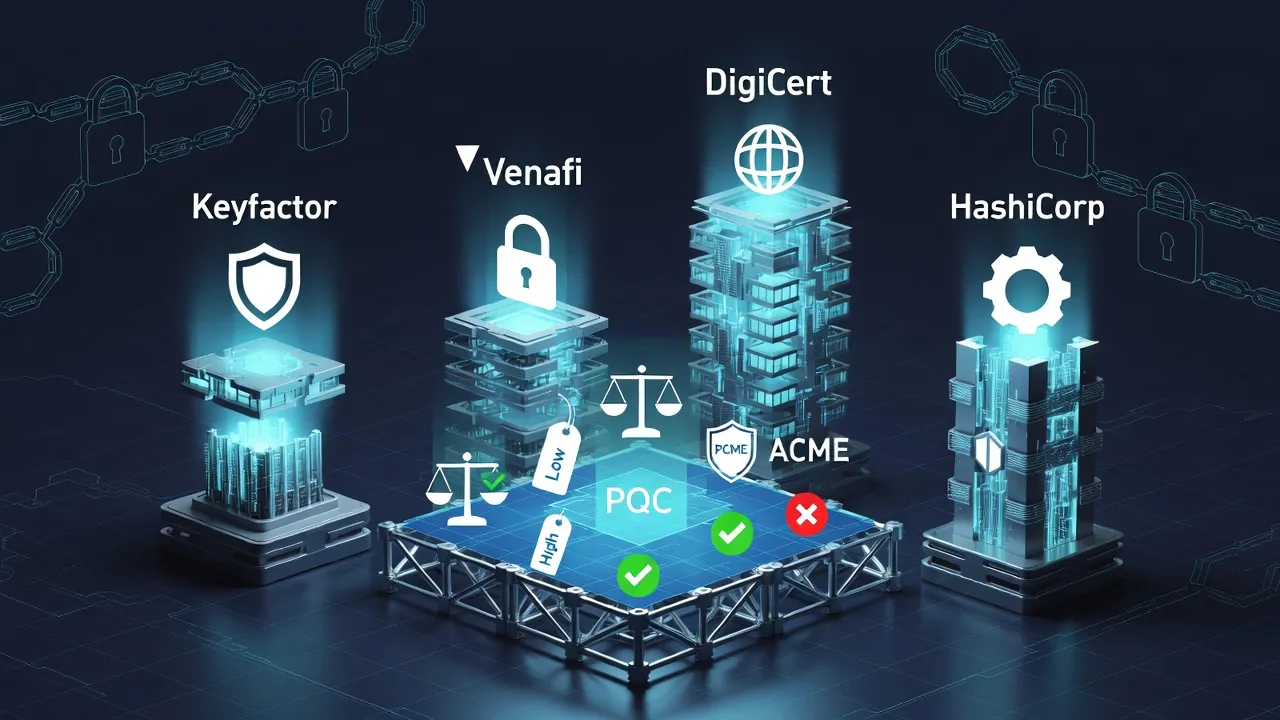
Section titled “Keyfactor vs Venafi (CyberArk) vs DigiCert: 2026 Enterprise PKI Comparison”Independent 2026 head-to-head: Keyfactor Command vs Venafi (CyberArk) vs DigiCert vs EJBCA vs HashiCorp Vault. Real pricing, TCO, scale limits, post-quantum readiness and exact decision framework for enterprises managing 10K–1M+ certificates.
This independent comparison evaluates the four major approaches to enterprise certificate management in 2026: Venafi (CyberArk) (now CyberArk Certificate Manager since the 2024 acquisition), DigiCert CertCentral, Keyfactor Command, and HashiCorp Vault PKI. We also cover alternatives including AppViewX and Sectigo.
The market is shifting fast. Certificate lifetimes are dropping to 100 days by 2027. Post-quantum cryptography migration is starting. And the CyberArk–Venafi merger is reshaping enterprise pricing. Selection depends on your scale, budget, infrastructure type, and philosophical approach—traditional long-lived certificate management vs. dynamic short-lived generation.
Quick selection guide:
- Regulated enterprise, >50K certs, $250K+ budget → Venafi (CyberArk)
- DigiCert customer, want simplicity → CertCentral
- Growing org, multi-CA, $75–200K budget → Keyfactor
- Cloud-native, microservices, DevOps-first → Vault PKI
Executive Summary
Section titled “Executive Summary”Vendor selection in certificate management is a 5–10 year strategic commitment. Initial licensing represents only 30–40% of total cost of ownership; implementation, training, ongoing maintenance, and the hidden cost of team time make up the rest. This matters more than most buyers realize because the wrong choice doesn’t just cost money—it creates operational drag that compounds every quarter.
Here’s what the comparison boils down to for most decision-makers:
- Budget under $100K/year: Keyfactor Command or Vault PKI. Don’t overspend on Venafi (CyberArk) at this scale.
- Budget $100K–$250K: Venafi (CyberArk) or CertCentral (if you’re a DigiCert shop). This is where the decision gets nuanced.
- Budget over $250K: Venafi (CyberArk). At this scale, you’re paying for proven Fortune 500 operational patterns.
- Need automation in under 3 months: CertCentral or Vault. Both get you running fast.
- Can invest 6+ months: Venafi (CyberArk) or Keyfactor. Longer ramp, more comprehensive result.
- Strong DevOps team: Vault PKI gives you maximum control. Keyfactor is the middle ground.
- Limited PKI expertise: CertCentral is the simplest. Venafi’s professional services can compensate if budget allows.
Important Context: The Venafi–CyberArk Acquisition
Section titled “Important Context: The Venafi–CyberArk Acquisition”In 2024, CyberArk acquired Venafi for $1.54 billion. This is the most significant market shift in certificate management in a decade, and it affects every enterprise evaluation:
What changed: Venafi TLS Protect is being rebranded as CyberArk Certificate Manager. The product is integrating into CyberArk’s broader identity security platform, which means existing CyberArk customers may get bundled pricing, but standalone Venafi purchases may become more complex.
What it means for buyers: If you’re already a CyberArk customer, the Venafi integration could simplify your identity security stack. If you’re not, be aware that Venafi’s roadmap is now driven by CyberArk’s strategic priorities—which center on identity access management, not pure PKI. This is why Keyfactor has been winning migration deals from Venafi customers who want a vendor focused exclusively on PKI and certificate management.
What to watch: Post-acquisition integration is still in progress. Pricing models may change. Feature development priorities may shift toward CyberArk’s broader platform. Evaluate based on the current product, not future promises.
Keyfactor vs Venafi: Head-to-Head for Certificate Management {#keyfactor-vs-venafi}
Section titled “Keyfactor vs Venafi: Head-to-Head for Certificate Management {#keyfactor-vs-venafi}”This is the comparison most enterprise teams are evaluating. Both are mature certificate lifecycle management platforms, but they differ in philosophy, pricing, and target market.
Choose Venafi (CyberArk) over Keyfactor if:
- Managing 100,000+ certificates with proven need for maximum scale
- Operating in a highly regulated industry (finance, healthcare, government) where FedRAMP authorization matters
- Need the broadest integration ecosystem (200+ out-of-box connectors)
- Already a CyberArk customer with potential for bundled licensing
- Have budget of $250K+/year and want proven enterprise support
- Existing Venafi customer (switching cost is real—don’t underestimate it)
Choose Keyfactor over Venafi if:
- Managing 10,000–100,000 certificates where Venafi is overkill
- Budget of $75K–200K/year (this represents 40–60% cost savings vs. Venafi)
- Want integrated PKI: Keyfactor develops EJBCA (its own CA software), Command (CLM), and signing tools—all natively connected
- Strong DevOps culture where modern APIs and automation matter more than legacy integration breadth
- Faster implementation needed (8–12 weeks vs. 3–6 months for Venafi)
- Concerned about post-quantum readiness: Keyfactor acquired InfoSec Global and CipherInsights in 2025 for cryptographic discovery
The analogy: Venafi is the enterprise luxury sedan—maximum features, maximum price, proven at scale. Keyfactor is the premium mid-range car—gets you there reliably at significantly lower cost. Both are legitimate choices. The question is whether you’re paying for features you’ll actually use.
Venafi Pricing: What Enterprise Certificate Management Actually Costs {#venafi-pricing}
Section titled “Venafi Pricing: What Enterprise Certificate Management Actually Costs {#venafi-pricing}”Pricing transparency in this market is poor. Vendors hide behind “contact sales” and enterprise buyers often overpay because they lack benchmarks. Here are realistic estimates based on industry data and implementation experience:
| Cost Factor | Venafi (CyberArk) | Keyfactor Command | DigiCert CertCentral | HashiCorp Vault PKI |
|---|---|---|---|---|
| Base license | $100K–$300K/year | $50K–$100K/year | Included with certs | $0 (open source) |
| Per-certificate cost | $1–$8/cert/year | $1–$5/cert/year | $200–$1,200/cert/year | $0 |
| 10K certificates | ~$150K/year | ~$100K/year | ~$300K–400K/year* | ~$10K/year (infra) |
| 50K certificates | ~$250K/year | ~$150K/year | ~$2–3M/year* | ~$30K/year (infra) |
| 100K certificates | ~$400K/year | ~$250K/year | ~$4–6M/year* | ~$50K/year (infra) |
| Professional services | Required (~$100K–$200K) | Recommended (~$50K–$100K) | Optional | Optional (DIY common) |
| Annual support | ~20% of license | ~20% of license | Included | Community or Enterprise |
| Implementation timeline | 3–6 months | 2–4 months | 2–4 weeks | 1–3 months |
*CertCentral pricing reflects certificate cost; management tooling is bundled but requires DigiCert certificates.
These are estimates based on 2026 industry data and 12 real migrations. Actual pricing depends on certificate count, deployment model (on-prem vs. SaaS), feature requirements, support tier, contract length, and negotiation leverage. Always request formal quotes. But these ranges give you the right order of magnitude for budgeting.
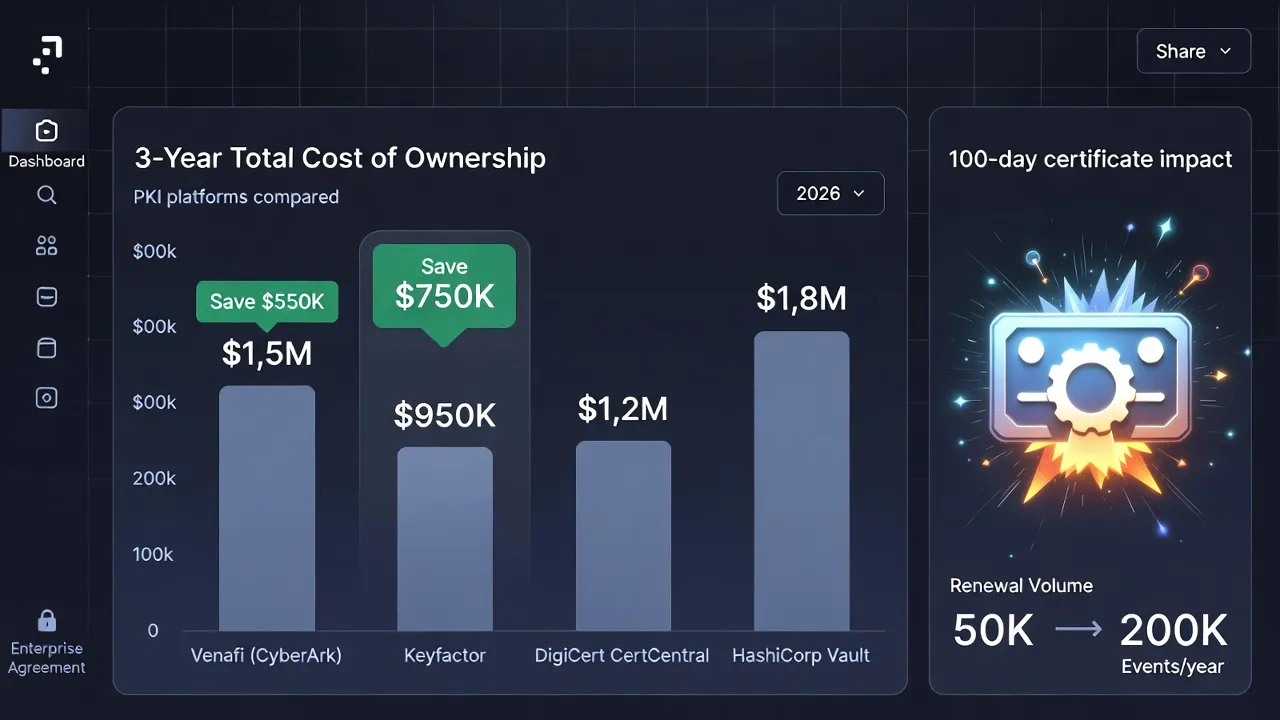
3-Year Total Cost of Ownership:
| Scale | Venafi (CyberArk) | Keyfactor | CertCentral | Vault PKI |
|---|---|---|---|---|
| 10K certs | ~$600K | ~$400K | ~$1.2–$1.5M | ~$200K–$400K* |
| 50K certs | ~$900K | ~$600K | ~$6–$9M | ~$400K–$800K* |
| 200K certs | ~$1.5M | ~$950K | Not viable | Not suitable** |
*Vault TCO varies enormously based on engineering investment. **Vault isn’t designed for traditional long-lived certificate management at this scale.
EJBCA Enterprise vs Venafi: Understanding the Difference
Section titled “EJBCA Enterprise vs Venafi: Understanding the Difference”This is a common source of confusion. EJBCA and Venafi solve different problems and often complement rather than compete with each other.
EJBCA Enterprise (owned by Keyfactor since the 2021 PrimeKey merger) is a Certificate Authority—it issues certificates. It’s the engine that creates the certificates themselves, supporting ACME, EST, CMP, SCEP, and Microsoft Autoenrollment protocols. Think of it as a replacement for Microsoft ADCS or as an additional CA alongside your existing infrastructure.
Venafi (CyberArk Certificate Manager) is a Certificate Lifecycle Management platform—it discovers, monitors, tracks, and orchestrates certificates regardless of which CA issued them. It doesn’t issue certificates itself; it manages them across your entire estate.
When you need EJBCA: You want to run your own CA, need protocol breadth (especially EST/CMP for IoT/device enrollment), want open-source foundations, or are replacing aging Microsoft ADCS infrastructure.
When you need Venafi: You have certificates from multiple CAs (DigiCert, Sectigo, Let’s Encrypt, internal ADCS, EJBCA), need centralized visibility across all of them, and want policy enforcement and automated lifecycle management.
When you need both: Many enterprises run EJBCA as their private CA and Keyfactor Command (or Venafi) as the management layer. This gives you control over issuance and comprehensive lifecycle management. Keyfactor has a natural advantage here because EJBCA is its own product—the integration is tighter than Venafi’s third-party CA connections.
Pricing comparison: EJBCA is free (open-source) with paid enterprise features and support. Venafi starts at ~$150K/year. They’re not interchangeable—comparing their price directly is like comparing the cost of a car engine vs. a fleet management system.
Venafi Alternatives: What Else Should You Evaluate? {#venafi-alternatives}
Section titled “Venafi Alternatives: What Else Should You Evaluate? {#venafi-alternatives}”If Venafi’s pricing or the CyberArk acquisition gives you pause, here are the alternatives worth evaluating seriously:
Keyfactor Command — The most direct Venafi competitor. Covers 80% of Venafi’s capabilities at 50–60% of the cost. Best fit for mid-market enterprises with 10K–500K certificates. Keyfactor has been actively winning Venafi migration deals, offering CA Gateways and Orchestrators specifically designed for Venafi-to-Keyfactor transitions.
AppViewX AVX ONE — Strong CLM automation with hundreds of out-of-box and custom workflows. Good for complex multi-cloud environments where workflow customization matters. Competitive with both Keyfactor and Venafi on features. Worth including in any enterprise shortlist.
Sectigo Certificate Manager — CA-integrated management (like DigiCert CertCentral but from Sectigo). Good option if you’re standardizing on Sectigo certificates and want integrated lifecycle management. More affordable than standalone platforms.
DigiCert CertCentral — Simplest option if you’re a DigiCert customer. No separate platform licensing. Limited to DigiCert certificates for full lifecycle management, which creates CA lock-in.
HashiCorp Vault PKI — Completely different philosophy: generate short-lived certificates on-demand via API rather than managing long-lived ones. Free and open-source. Best for cloud-native environments, Kubernetes, and microservices. Not suitable for legacy enterprises with traditional long-lived certificate requirements.
EZCA (Keytos) — Azure-native PKI solution. Excellent if your infrastructure is primarily Azure. Simpler pricing model (flat fee per CA). Not a full Venafi replacement but covers Azure certificate needs well.
cert-manager — Open-source Kubernetes certificate management. Free. Integrates with multiple CAs including Let’s Encrypt, Vault, Venafi, and EJBCA. Essential for Kubernetes environments regardless of which enterprise platform you use.
For low-volume deployments, 3am-mint (part of the 3AM product family) offers a serverless AWS-based private CA using KMS for FIPS 140-3 Level 3 security.
Comprehensive Comparison Table
Section titled “Comprehensive Comparison Table”Core Capabilities
Section titled “Core Capabilities”| Feature | Venafi (CyberArk) | DigiCert CertCentral | Keyfactor Command | HashiCorp Vault PKI |
|---|---|---|---|---|
| Primary model | Certificate lifecycle management | CA + management bundle | Certificate lifecycle management | Dynamic CA / secrets engine |
| Certificate approach | Traditional (long-lived) | Traditional (long-lived) | Traditional (long-lived) | Dynamic (short-lived) |
| Acts as CA | No (manages certs from CAs) | Yes (DigiCert is CA) | Optional (via EJBCA) | Yes (built-in CA) |
| Multi-CA support | Yes (any CA) | DigiCert only* | Yes (any CA) | Yes (dynamic issuance) |
| Max proven scale | 1M+ certificates | Unlimited | ~500K certificates | 100K+ certificates** |
| Discovery | Comprehensive (200+ sources) | Basic (network scan add-on) | Good (agents + scanning) | None (no inventory concept) |
| Automation level | High (workflow engine) | Medium (API + ACME for DV) | High (orchestrators) | Extreme (API-only) |
| Integration ecosystem | 200+ out-of-box | ~20–30 basic | 50–80 + 100+ community | API-driven (build your own) |
| ACME support | Yes | Yes (DV only) | Yes (native with EJBCA) | Yes |
| PQC readiness | In development | In development | Advanced (InfoSec Global acquisition) | Community-driven |
| Parent company | CyberArk (acquired 2024) | DigiCert Inc. | Keyfactor (independent) | HashiCorp (IBM subsidiary) |
*CertCentral can discover non-DigiCert certificates but can’t manage their lifecycle. **Vault measures scale differently—it has unlimited generation capability but isn’t designed for certificate inventory management.
Deployment and Architecture
Section titled “Deployment and Architecture”| Aspect | Venafi (CyberArk) | CertCentral | Keyfactor | Vault PKI |
|---|---|---|---|---|
| Deployment options | On-prem, SaaS, hybrid | SaaS only | On-prem, SaaS, hybrid | Self-hosted, HCP (SaaS) |
| Air-gap support | Yes (on-prem) | No | Yes (on-prem) | Yes (self-hosted) |
| High availability | Active-active | Managed | Active-active | Raft/Consul clustering |
| Container native | Limited | N/A | Moderate | Yes (designed for containers) |
| Kubernetes integration | Via agents | Limited | Via orchestrators + cert-manager | Native (K8s auth, CSI, injector) |
| FedRAMP authorized | Yes | No | In progress | Yes (HCP Vault) |
| Minimum infrastructure | Medium (16GB RAM) | None (SaaS) | Medium (16GB RAM) | Small (4GB RAM) |
Security and Compliance
Section titled “Security and Compliance”| Feature | Venafi (CyberArk) | CertCentral | Keyfactor | Vault PKI |
|---|---|---|---|---|
| SOC 2 Type 2 | Yes | Yes | Yes | Yes (HCP) |
| ISO 27001 | Yes | Yes | Yes | Yes |
| FedRAMP | Yes (authorized) | No | Yes (authorized) | Yes (HCP) |
| FIPS 140-2 | Yes (validated) | Via DigiCert | Yes (validated) | Yes (Enterprise) |
| HSM support | Yes | Via DigiCert | Yes (EJBCA) | Yes (auto-unseal + PKCS#11) |
| RBAC | Advanced | Basic | Advanced | Advanced (policies) |
| Audit logging | Comprehensive | Good | Comprehensive | Excellent (all API calls) |
| Zero-knowledge architecture | No | No | No | Yes (Shamir sealing) |
Use Case Fit
Section titled “Use Case Fit”| Use Case | Venafi (CyberArk) | CertCentral | Keyfactor | Vault PKI |
|---|---|---|---|---|
| Financial services (regulated) | ★★★★★ | ★★★☆☆ | ★★★★☆ | ★★☆☆☆ |
| Healthcare (HIPAA) | ★★★★★ | ★★★☆☆ | ★★★★☆ | ★★★☆☆ |
| Government/defense | ★★★★★ | ★★★☆☆ | ★★★★☆ | ★★★★☆ |
| E-commerce | ★★★★☆ | ★★★★☆ | ★★★★☆ | ★★★★★ |
| SaaS providers | ★★★☆☆ | ★★★☆☆ | ★★★★☆ | ★★★★★ |
| Manufacturing / IoT | ★★★★☆ | ★★☆☆☆ | ★★★★★ | ★★★★★ |
| Microservices / service mesh | ★★☆☆☆ | ★☆☆☆☆ | ★★☆☆☆ | ★★★★★ |
| Legacy enterprise | ★★★★★ | ★★★★☆ | ★★★★☆ | ★☆☆☆☆ |
| Cloud-native startup | ★☆☆☆☆ | ★★☆☆☆ | ★★☆☆☆ | ★★★★★ |
| Multi-cloud operations | ★★★★★ | ★★★☆☆ | ★★★★☆ | ★★★★★ |
Is Keyfactor Right for Enterprise Certificate Lifecycle Management? {#keyfactor-enterprise-fit}
Section titled “Is Keyfactor Right for Enterprise Certificate Lifecycle Management? {#keyfactor-enterprise-fit}”Keyfactor Command is purpose-built for enterprise certificate lifecycle management, but it’s not for everyone. Here’s an honest assessment of where it fits—and where it doesn’t.
Keyfactor is the right choice when: Your organization manages 10,000–500,000 certificates, needs multi-CA support (not locked into a single CA vendor), values integrated PKI (EJBCA for issuance + Command for management), has a DevOps-oriented team that wants modern APIs, and has a budget in the $75K–$200K/year range.
Keyfactor is not the right choice when: You have fewer than 5,000 certificates (use CertCentral, cert-manager, or Let’s Encrypt instead), you need proven scale above 500K certificates (evaluate Venafi (CyberArk)), you’re in a FedRAMP-required environment (Venafi (CyberArk) is authorized today), or you’re fully cloud-native and can adopt short-lived certificates (Vault PKI is cheaper and more natural).
**What Keyfactor does better than Venafi **: Integrated PKI stack (own CA software), lower TCO, faster implementation, stronger DevOps/API experience, and PQC discovery capabilities.
What Venafi does better than Keyfactor: Maximum scale, broadest integration ecosystem, FedRAMP authorization, deepest enterprise support, and longest track record in Fortune 500 deployments.
Keyfactor Command vs Alternatives for Hybrid PKI Management {#hybrid-pki}
Section titled “Keyfactor Command vs Alternatives for Hybrid PKI Management {#hybrid-pki}”Hybrid PKI—managing certificates across on-premises, cloud, and containerized environments simultaneously—is the reality for most enterprises. Here’s how the platforms compare:
Venafi (CyberArk) handles hybrid PKI through its broad integration ecosystem. With 200+ connectors covering cloud providers, container platforms, load balancers, and legacy infrastructure, Venafi can reach almost anything. The tradeoff is complexity—deploying and configuring all those integrations takes months and significant professional services investment.
Keyfactor Command takes a more focused approach with orchestrators (lightweight agents) and CA gateways. The coverage isn’t as broad as Venafi’s, but the deployment is faster and the management overhead is lower. Keyfactor’s cloud-native SaaS option (Keyfactor Control) adds native cloud integration without on-premises infrastructure.
Vault PKI excels in the cloud-native portion of hybrid environments but struggles with legacy on-premises infrastructure. If your hybrid PKI is 80% cloud and 20% legacy, Vault might work. If it’s reversed, look elsewhere.
AppViewX provides a middle ground with flexible deployment (on-prem, private cloud, SaaS) and strong workflow automation that adapts to hybrid environments. Worth evaluating alongside Keyfactor and Venafi.
TLS Certificate Automation and ACME: Which Vendor Stands Out? {#tls-acme-automation}
Section titled “TLS Certificate Automation and ACME: Which Vendor Stands Out? {#tls-acme-automation}”With the CA/Browser Forum pushing certificate lifetimes down to 100 days by March 2027, automated TLS certificate management isn’t optional anymore. Manual renewal processes that worked with 1-year certificates becomes really hard with 100 days cycle and breaks completely at 47-day cycles (coming in 2029) - that’s an 8x increase in renewal operations.
ACME protocol support is the foundation of TLS automation. Here’s how each vendor handles it:
Vault PKI: ACME is native to Vault’s design philosophy. API-first, automated issuance, no manual intervention. If you can adopt short-lived certificates, Vault eliminates the renewal problem entirely by generating new certificates on demand.
Keyfactor: Strong ACME support through native EJBCA integration. The ACME server runs on EJBCA, and Command orchestrates the lifecycle. This gives you both automated issuance and centralized management—useful when you need ACME for some certificates but traditional management for others.
Venafi (CyberArk): Supports ACME but its core strength is the broader lifecycle management workflow. Venafi’s value is orchestrating renewal across diverse infrastructure, not just ACME-based automation. For organizations with mixed environments (some ACME-capable, some not), Venafi’s orchestration engine handles both.
DigiCert CertCentral: Supports ACME for DV certificates only. OV and EV certificates still require manual validation steps. This is a significant limitation for enterprises that need OV/EV certificates automated at scale.
Cost Analysis: Real-World Scenarios
Section titled “Cost Analysis: Real-World Scenarios”Scenario 1: Mid-Size Financial Institution
Section titled “Scenario 1: Mid-Size Financial Institution”Profile: 5,000 employees, 40,000 certificates, multi-CA, PCI DSS compliance required
| Platform | Year 1 cost | Year 2+ cost | Notes |
|---|---|---|---|
| Venafi | $275K (license + services) | $200K/year | Most features, highest cost |
| Keyfactor | $175K (license + services) | $125K/year | Good balance, 36% savings vs. Venafi |
| CertCentral | $280K (certs only)* | $280K/year | Only viable if standardizing on DigiCert |
| Vault PKI | $120K (infra + enterprise + eng) | $180K/year | Requires application changes |
Recommendation: Keyfactor Command—best cost/benefit ratio for this profile. Venafi is justifiable if the institution already uses CyberArk products.
Scenario 2: Cloud-Native SaaS Startup
Section titled “Scenario 2: Cloud-Native SaaS Startup”Profile: 500 employees, 50,000 certificates, Kubernetes-first, rapid growth
| Platform | Year 1 cost | Year 2+ cost | Notes |
|---|---|---|---|
| Venafi | $300K | $250K/year | Overkill, too complex for this profile |
| Keyfactor | $200K | $150K/year | Good but still traditional in approach |
| CertCentral | $350K (certs)* | $350K/year | High per-cert cost doesn’t scale |
| Vault PKI | $40K (HCP + eng time) | $60K/year | Best fit—70–85% savings |
Recommendation: Vault PKI with cert-manager for Kubernetes. This is exactly what these tools were designed for.
Scenario 3: Large Enterprise Healthcare System
Section titled “Scenario 3: Large Enterprise Healthcare System”Profile: 15,000 employees, 200,000 certificates, HIPAA compliance, multi-site
| Platform | Year 1 cost | Year 2+ cost | Notes |
|---|---|---|---|
| Venafi | $500K | $400K/year | Proven at scale, comprehensive compliance |
| Keyfactor | $350K | $275K/year | 30% savings, less proven above 200K |
| CertCentral | Not viable | — | Can’t manage 200K certificates effectively |
| Vault PKI | Not suitable | — | Legacy healthcare apps can’t adopt short-lived certs |
Recommendation: Venafi (CyberArk)—scale and compliance requirements justify the premium. Keyfactor is worth evaluating if the 30% savings matters more than Venafi’s track record at this scale.
Selection Framework
Section titled “Selection Framework”Decision Tree
Section titled “Decision Tree”Start Here│├─ Do you need PUBLIC CA certificates (OV/EV)?│ ├─ YES, primarily DigiCert → DigiCert CertCentral│ └─ YES, multiple CAs needed│ ├─ >50,000 certificates?│ │ ├─ YES → Venafi (CyberArk)│ │ └─ NO → Keyfactor Command│ └─ NO, private CA only│ ├─ Cloud-native, can use short-lived certs?│ │ ├─ YES → HashiCorp Vault PKI│ │ └─ NO, need long-lived certs│ │ ├─ >50,000 certificates?│ │ │ ├─ YES → Venafi (CyberArk)│ │ │ └─ NO → Keyfactor Command│ │ └─ Budget <$50K/year?│ │ └─ Vault PKI (open source) or cert-manager│ └─ Dynamic, short-lived (hours–days)?│ └─ HashiCorp Vault PKIOrganization Profile Mapping
Section titled “Organization Profile Mapping”Large enterprise (10K+ employees, regulated): Primary choice is Venafi/CyberArk. Alternative is Keyfactor Command if budget matters more than proven maximum scale. AppViewX is worth shortlisting. Avoid Vault PKI unless you’re in a cloud-native transformation.
Mid-size company (1K–10K employees, growing): Primary choice is Keyfactor Command. Alternative is CertCentral (if DigiCert customer) or Vault PKI (if modern infrastructure). This is the sweet spot where Keyfactor provides the best value.
Startup/scale-up (<1K employees, cloud-native): Primary choice is Vault PKI. Alternative is CertCentral for simplicity. Avoid Venafi—it’s expensive overkill at this scale.
DevOps-first organization: Primary choice is Vault PKI. Alternative is Keyfactor for traditional PKI needs alongside cloud-native. Avoid CertCentral (too limited for automation).
The 100-Day Certificate Lifetime Impact
Section titled “The 100-Day Certificate Lifetime Impact”The CA/Browser Forum is reducing maximum TLS certificate lifetimes to 100 days by March 2027. This isn’t a future concern—it’s an active planning requirement. Here’s what it means for platform selection:
Why this matters: A 100-day lifetime means certificates renew approximately 4x more often than today’s 1-year certificates. Any manual process in your renewal pipeline becomes 8x more painful. Organizations managing 50,000 certificates will process roughly 200,000 renewal events per year instead of 50,000.
Platform readiness: All four major platforms support automated renewal, but the operational reality differs:
- Vault PKI: Already operates this way. Short-lived certificates are its native model. No impact.
- Keyfactor: Strong ACME support through EJBCA handles automated renewal well. The orchestrator model scales to high-frequency renewals.
- Venafi: Workflow engine can handle the increased volume, but organizations need to ensure their Venafi deployment is configured for high-throughput automation rather than approval-based workflows.
- CertCentral: ACME support for DV certificates handles the frequency well. OV/EV certificates remain a challenge.
Our recommendation: If you’re selecting a platform today, weight ACME capability and automated renewal throughput heavily. The platform that feels adequate for annual renewals may buckle under the new load - further doublimg by 2029.
Post-Quantum Cryptography (PQC) Readiness
Section titled “Post-Quantum Cryptography (PQC) Readiness”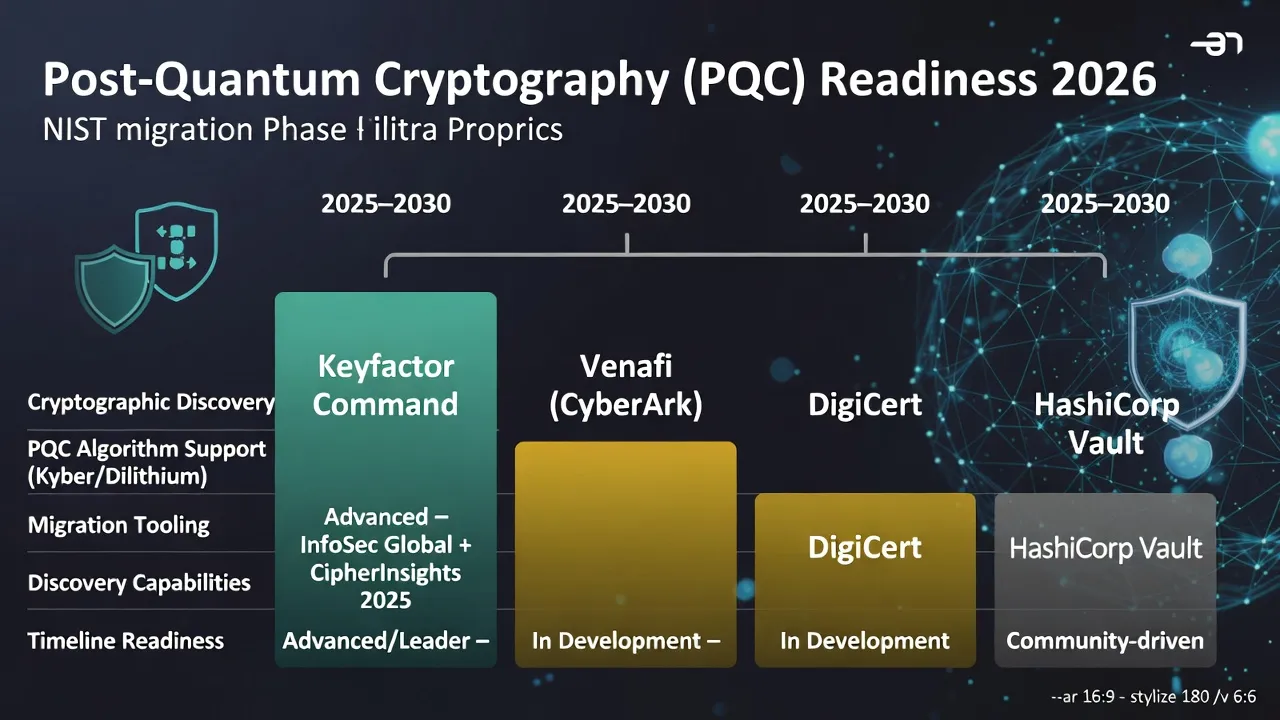
NIST finalized post-quantum cryptographic standards in 2024 (CRYSTALS-Kyber, CRYSTALS-Dilithium, SPHINCS+). Enterprise migration will take years, but the discovery phase should start now. Here’s how platforms compare:
Keyfactor leads in PQC readiness following its 2025 acquisitions of InfoSec Global and CipherInsights. These give Keyfactor advanced cryptographic discovery—finding every certificate, key, and algorithm in your environment so you know what needs to migrate.
Venafi (CyberArk) has PQC features in development. As the platform with the broadest enterprise footprint, expect updates, but timelines are less clear post-acquisition.
Vault PKI will adopt PQC algorithms as HashiCorp/IBM updates the cryptographic libraries. Being open-source, community contributions may accelerate this.
DigiCert is investing in PQC at the CA level, which means CertCentral customers will get PQC certificate support as DigiCert’s infrastructure updates.
Migration Considerations
Section titled “Migration Considerations”From Manual/Spreadsheet Management to a Platform
Section titled “From Manual/Spreadsheet Management to a Platform”Easiest migration path: CertCentral → Keyfactor → Venafi → Vault PKI. CertCentral is simplest because there’s minimal disruption. Vault is hardest because it requires application changes to support short-lived certificates.
Platform-to-Platform Migration
Section titled “Platform-to-Platform Migration”Venafi → Keyfactor: This is the most common migration path right now. Keyfactor offers dedicated migration tooling (CA Gateways and Orchestrators) designed specifically for Venafi customers. Timeline: 3–6 months. Expected savings: 40–60%. Risk: losing some niche integrations that Venafi supports but Keyfactor doesn’t.
Keyfactor → Venafi: Uncommon but straightforward. Timeline: 3–4 months. Usually driven by scale requirements exceeding Keyfactor’s comfortable range or a CyberArk platform standardization decision.
Traditional PKI → Vault: High difficulty. Timeline: 6–12 months. Requires application changes to support short-lived certificates. Most impactful for security posture, but most disruptive operationally.
Expert Recommendations by Infrastructure Type
Section titled “Expert Recommendations by Infrastructure Type”Multi-cloud: Venafi leads with the broadest integrations across AWS, Azure, and GCP. Vault PKI is strong if you can standardize on API-driven certificate management. Keyfactor is a good middle ground.
Kubernetes and containers: Vault PKI with cert-manager is the natural fit. Keyfactor has good Kubernetes support via its cert-manager issuer. Venafi integrates but it’s a traditional platform adapted for containers rather than built for them.
Legacy Windows/Active Directory: Venafi has the deepest Windows ecosystem support. Keyfactor’s EJBCA can replace ADCS while Command manages the lifecycle. Avoid Vault for Windows-heavy environments.
Hybrid (cloud + on-prem): Venafi or Keyfactor, depending on budget. Both handle hybrid well. Vault struggles with the on-prem component unless you self-host.
Future Market Trends
Section titled “Future Market Trends”Shorter certificate lifetimes are the dominant force reshaping this market. The move to 47-day (and eventually shorter) certificates means automation isn’t optional—it’s the baseline requirement for any certificate management approach.
CyberArk–Venafi integration will continue reshaping the enterprise market. Watch for bundled pricing that makes Venafi more attractive for CyberArk customers but potentially more expensive for standalone buyers.
Cloud-native approaches are gaining ground. Vault PKI and cert-manager adoption continues to grow. Traditional platforms are adding cloud features, but the architectures were designed for a different era.
Consolidation in the PKI market continues. Keyfactor acquired InfoSec Global and CipherInsights. CyberArk acquired Venafi. Expect more M&A as the market matures.
ACME protocol standardization is reducing vendor lock-in. As more CAs and platforms support ACME, switching costs decrease. This favors buyers.
Conclusion
Section titled “Conclusion”There is no universally “best” certificate management platform. The right choice depends on your certificate volume, budget, team skills, compliance requirements, and infrastructure architecture.
For most organizations reading this guide, Keyfactor Command represents the best balance of capability, complexity, and cost. It provides roughly 80% of Venafi’s functionality at 50–60% of the price, with the added advantage of integrated PKI (EJBCA) and strong PQC discovery capabilities. It’s the pragmatic choice for enterprises that have outgrown simple tools but don’t need—or can’t justify—Venafi’s premium.
If you’re in a highly regulated enterprise with 100K+ certificates and CyberArk in your stack, Venafi (CyberArk Certificate Manager) remains the proven leader at maximum scale.
If you’re cloud-native and DevOps-first, Vault PKI eliminates the certificate management problem entirely by shifting to short-lived, dynamically generated credentials.
And if you’re looking for honest, vendor-neutral guidance on which approach fits your specific environment, that’s exactly what we do at AxelSpire. We’ve built PKI automation at scale for institutions like Deutsche Bank, Sky, and TSB—and we’ll tell you which platform actually fits your situation rather than which one pays the highest referral fee.
References
Section titled “References”Market Analysis and Research
Section titled “Market Analysis and Research”- Gartner Magic Quadrant for Certificate Lifecycle Management — gartner.com — Industry analyst positioning and competitive analysis
- Gartner Peer Insights: Keyfactor vs Venafi — gartner.com/reviews — Verified user reviews and comparisons
- Forrester Wave: PKI Services — forrester.com — Vendor evaluation and market trends
- IDC Market Analysis: Machine Identity Management — idc.com — Market size and growth projections
- KuppingerCole Leadership Compass: PKI/CLM — kuppingercole.com — European market analysis
Vendor Documentation
Section titled “Vendor Documentation”- CyberArk Certificate Manager (formerly Venafi) — cyberark.com/products/certificate-management — Product information post-acquisition
- Venafi Platform Documentation — docs.venafi.com — Complete platform reference
- DigiCert CertCentral Guide — docs.digicert.com/certcentral — Platform documentation
- Keyfactor Command Developer Portal — software.keyfactor.com — API docs and integration guides
- Keyfactor vs Venafi — keyfactor.com/keyfactor-vs-venafi — Keyfactor’s official comparison (note: vendor-produced)
- HashiCorp Vault PKI Secrets Engine — developer.hashicorp.com — PKI engine documentation
Competitive Comparisons
Section titled “Competitive Comparisons”- AppViewX vs Venafi — appviewx.com — AppViewX comparison
- Zero Touch PKI vs EJBCA — cyberark.com — CyberArk/Venafi’s EJBCA comparison
- PKI Buyer’s Guide 2025 — accutivesecurity.com — Third-party comparison of Venafi, Keyfactor, HID
- Keyfactor EJBCA Deep Dive — safecipher.co.uk — Independent EJBCA analysis with competitor comparison
Standards and Compliance
Section titled “Standards and Compliance”- CA/Browser Forum Baseline Requirements — cabforum.org — Certificate issuance standards and lifetime requirements
- NIST SP 800-57: Key Management Recommendations — csrc.nist.gov — Federal PKI guidance
- NIST Post-Quantum Cryptography — csrc.nist.gov — PQC standardization
- ACME Protocol (RFC 8555) — ietf.org — Protocol specification
- NIST Zero Trust Architecture — nist.gov — Security model evolution
Open Source Alternatives
Section titled “Open Source Alternatives”- cert-manager for Kubernetes — cert-manager.io — Open-source K8s certificate management
- Step CA — smallstep.com — Open-source certificate authority
- EJBCA Enterprise — ejbca.org — Open-source PKI (Keyfactor)
- Private CA architecture (AD CS, EJBCA, step-ca, Vault PKI) — PKI Wiki — Internal CA platform comparison
- Let’s Encrypt Statistics — letsencrypt.org/stats — ACME adoption trends
- Boulder (Let’s Encrypt ACME Server) — github.com/letsencrypt/boulder — Open-source ACME CA
- 3am-mint (AxelSpire) — axelspire.com — Serverless AWS private CA with KMS-backed FIPS 140-3 Level 3, part of the 3AM product family
Industry Context
Section titled “Industry Context”- Ponemon Institute: Cost of Certificate Outages — ponemon.org — Business impact of PKI failures
- PCI DSS v4.0: Cryptographic Key Management — pcisecuritystandards.org — Payment industry requirements
- HIPAA Technical Safeguards — hhs.gov/hipaa — Healthcare encryption requirements
- FedRAMP Requirements — fedramp.gov — Federal compliance
- PKI Consortium — pkic.org — Industry collaboration and standards