
IoT Device Identity Certificates: Who Owns Them, Who Controls Them, and Why It Matters at Scale
Part of the IoT Certificate Management pillar. This page explains what IoT device identity certificates are, the standards that define them, how platform choices determine who actually controls your device identities — and why building your own infrastructure before you need it is cheaper than escaping lock-in later.
What IoT Device Identity Certificates Are and Why Every Device Needs One
An IoT device identity certificate is a unique X.509 digital certificate that gives a connected device a cryptographically verifiable identity. It binds a public key to device-specific attributes — manufacturer, model, serial number — and is signed by a trusted Certificate Authority (CA). The corresponding private key, stored on the device itself (ideally in a hardware secure element), lets the device prove its identity to any network, cloud service, or peer device that trusts the issuing CA.
Without IoT device identity certificates, there is no reliable way to distinguish a genuine device from a counterfeit one, no basis for encrypted communication, and no mechanism for controlling which devices can join a network or receive firmware updates. Every IoT security architecture — from consumer smart home to industrial control systems — depends on this foundation.
PKI Health Radar
Drag the sliders to assess your current posture — scores update instantly.
Two standards define how IoT device identity certificates work in practice, and understanding both is essential for making architectural decisions that hold up across device types and regulatory regimes.
IEEE 802.1AR: The Standard for Secure Device Identity
IEEE 802.1AR defines how network-connected devices establish cryptographically verifiable identities using X.509 certificates. It specifies two certificate types that map to the two phases of a device's operational life:
Initial Device Identifier (IDevID): A certificate provisioned by the manufacturer during production. The IDevID is immutable — it identifies the device for its entire lifetime, regardless of who operates it or what network it joins. The private key is generated on the device (or injected into a secure element) and should never be extractable.
Locally Significant Device Identifier (LDevID): A certificate assigned by the network operator after the device is deployed. The LDevID is used for ongoing authentication within a specific operational environment and can be renewed, rotated, or revoked independently of the IDevID.
This two-layer model — manufacturer-provisioned identity for attestation, operator-assigned identity for operations — is the foundational pattern for IoT device identity management. It appears in industrial standards like IEC 62443, in OPC UA's built-in certificate management (OPC 10000-12), and in the Matter standard's PKI hierarchy.
Matter's Parallel: DAC and NOC
The Matter PKI hierarchy follows a structurally similar pattern to IEEE 802.1AR:
The Device Attestation Certificate (DAC) serves the same role as an IDevID — a manufacturer-provisioned certificate proving the device is genuine and Matter-certified. It chains through a Product Attestation Intermediate (PAI) to a Product Attestation Authority (PAA) registered on the CSA's Distributed Compliance Ledger.
The Network Operational Certificate (NOC) mirrors the LDevID — an operator-assigned credential issued by the fabric commissioner for encrypted communication within a specific Matter fabric.
Understanding this parallel matters because the architectural decisions are the same regardless of which standard applies: who provisions the manufacturer identity, who issues the operational identity, where the private keys live, and — critically — who controls the CA infrastructure behind both.
That last question is where most organisations get into trouble.
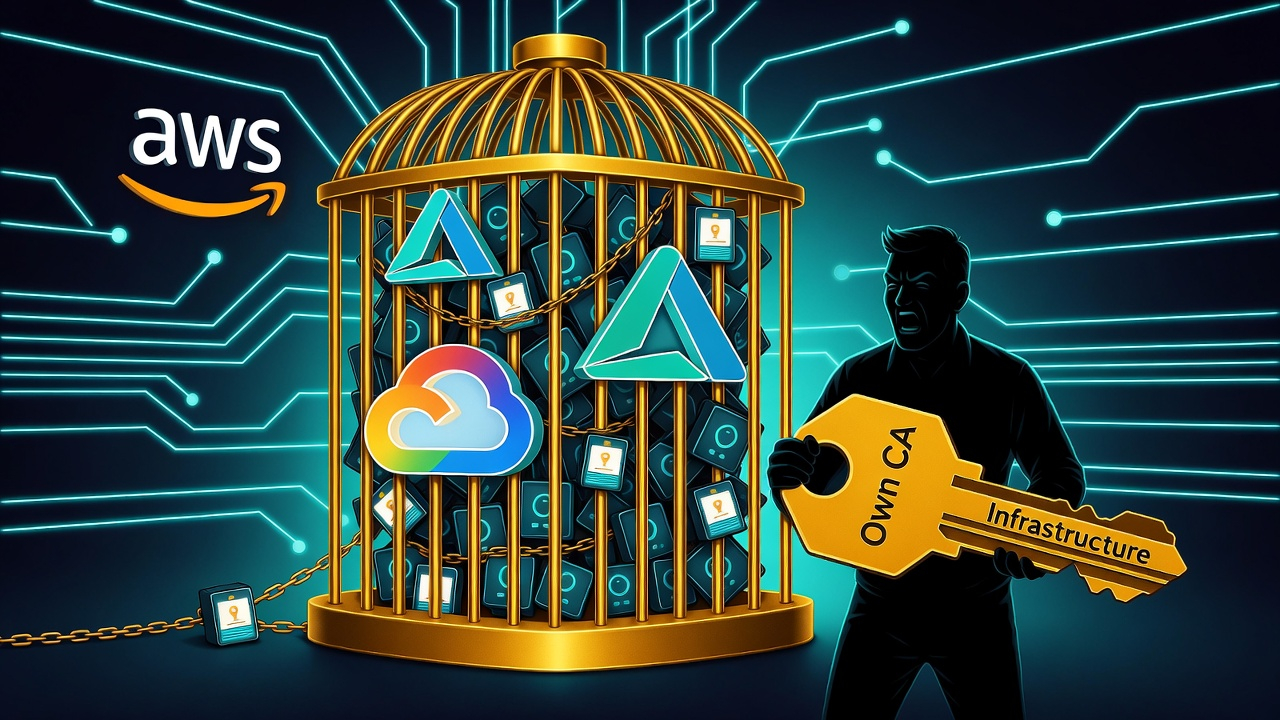
The Convenience Trap: How Cloud Platforms Capture IoT Device Identity
Every major cloud platform offers a managed IoT device identity service. AWS IoT Core handles certificate provisioning, authentication, and lifecycle management. Azure IoT Hub provides device identity registry and X.509 certificate authentication. Google Cloud's IoT services offered equivalent capabilities until Google discontinued Cloud IoT Core in August 2023 — a fact that should give every product team pause.
These services are genuinely good. They solve the immediate problem of getting IoT device identity certificates provisioned and authenticated against your cloud backend. They integrate with the platform's other services — compute, storage, analytics, machine learning. They scale well, they're well-documented, and they significantly reduce the initial engineering effort to get a connected product to market.
They also create structural dependency that becomes expensive to reverse.
IoT network operators and enterprise teams who run their own Matter fabrics face the same lock-in risk — their device identities become tied to whatever platform they initially chose, making self-managed, portable certificate infrastructure even more valuable.
We've written extensively about vendor lock-in in enterprise certificate management — the dynamics that make Keyfactor and Venafi customers stay even when pricing increases, because the migration cost exceeds the additional spend. The same dynamics apply to IoT platforms, amplified by the fact that IoT device identity certificates are embedded in hardware that's already been shipped to consumers.
How Platform Lock-In Manifests in IoT Device Identity Management
The Device Identity Chain
When you use AWS IoT Core for device identity management, your devices authenticate using certificates issued by AWS Private CA or registered with AWS IoT. The certificate chain typically roots to an AWS-operated or AWS-hosted CA. Your device firmware includes AWS IoT SDK code for authentication, message routing, and device shadow management.
This creates a multi-layer dependency:
Certificate authority dependency. Your IoT device identity certificates chain to a CA that AWS operates or hosts. Moving to a different platform means either re-issuing all device certificates (impossible for devices already in consumers' homes without firmware updates and new provisioning) or cross-certifying your CA with the new platform (complex and often not supported).
SDK and protocol dependency. Your firmware uses the AWS IoT Device SDK for MQTT communication, authentication, and device management. Moving to Azure IoT Hub means replacing the SDK, changing authentication flows, and updating device firmware across your entire fleet.
Data and state dependency. Device shadows, reported states, and operational metadata live in AWS IoT. Moving means migrating device state data and rebuilding the management layer on a new platform.
Monitoring and analytics dependency. Your device certificate telemetry, authentication logs, and behavioural analytics pipeline is built on AWS services (CloudWatch, IoT Analytics, SageMaker). Moving means rebuilding your monitoring architecture from scratch.
What Happens When the Lock-In Bites
The dependency seems manageable when you have 1,000 devices in a pilot programme. It becomes acute when you have 250,000 devices in production and any of the following occur:
Pricing changes. AWS adjusts IoT Core pricing — which they've done before. Your per-device cost increases by 40%. You can't migrate without a fleet-wide firmware update, which itself costs more than the price increase. You pay.
Service deprecation. Google discontinued Cloud IoT Core in August 2023, giving customers 18 months to migrate. Organisations with millions of IoT device identity certificates tied to Google's platform faced significant re-architecture costs. This isn't hypothetical — it happened.
Multi-cloud requirements. Your enterprise customers require devices that work with their preferred cloud provider. If your devices are hardcoded to authenticate against AWS IoT Core, you can't serve Azure-only enterprises without maintaining parallel firmware builds and separate certificate management infrastructure.
Compliance requirements change. The EU Cyber Resilience Act requires manufacturers to ensure product security throughout the lifecycle. If your certificate management depends on a third-party platform, your compliance posture depends on that platform's continued operation and security practices.
Acquisition or merger. Your company is acquired by an organisation standardised on a different cloud provider. All device infrastructure must migrate. The IoT device identity certificates embedded in 500,000 devices don't migrate without firmware updates — which the acquiring company may not want to fund.
Better pricing elsewhere. A competitor platform offers equivalent IoT services at 50% lower cost. You can't switch because your device identities are structurally bound to the current platform.
The "But AWS Private CA Is Ours" Argument
A common counter-argument: "We operate our own CA through AWS Private CA. We control the root. We can move."
This is partially true. If you operate a private CA through AWS Private CA, you do control the root certificate and can, in principle, issue the same root to a different platform. But:
The CA's private key is in AWS's HSM infrastructure. You trust AWS's security, but you don't control the physical environment. Moving your CA to a different platform means either re-keying (issuing a new root and distributing it to all devices) or exporting the key (which AWS Private CA supports for root CAs, but the operational process is non-trivial).
Your issuance infrastructure is AWS-native. Certificate issuance pipelines, Lambda functions for provisioning, CloudFormation templates for CA hierarchy management — all built on AWS. Moving the CA key doesn't move the operational infrastructure.
Matter PAA registration is tied to a specific root. If you've registered your AWS-hosted PAA root with the CSA's Distributed Compliance Ledger, moving to a different CA infrastructure means either re-registering (keeping the same root key) or registering a new PAA (which means newly manufactured devices chain to a different root than existing ones).
The operational reality is that "owning your CA" on a cloud platform gives you cryptographic ownership but not operational independence. The switching cost isn't zero — it's lower than full platform lock-in, but it's still substantial.
The Alternative: Platform-Independent IoT Device Identity Architecture
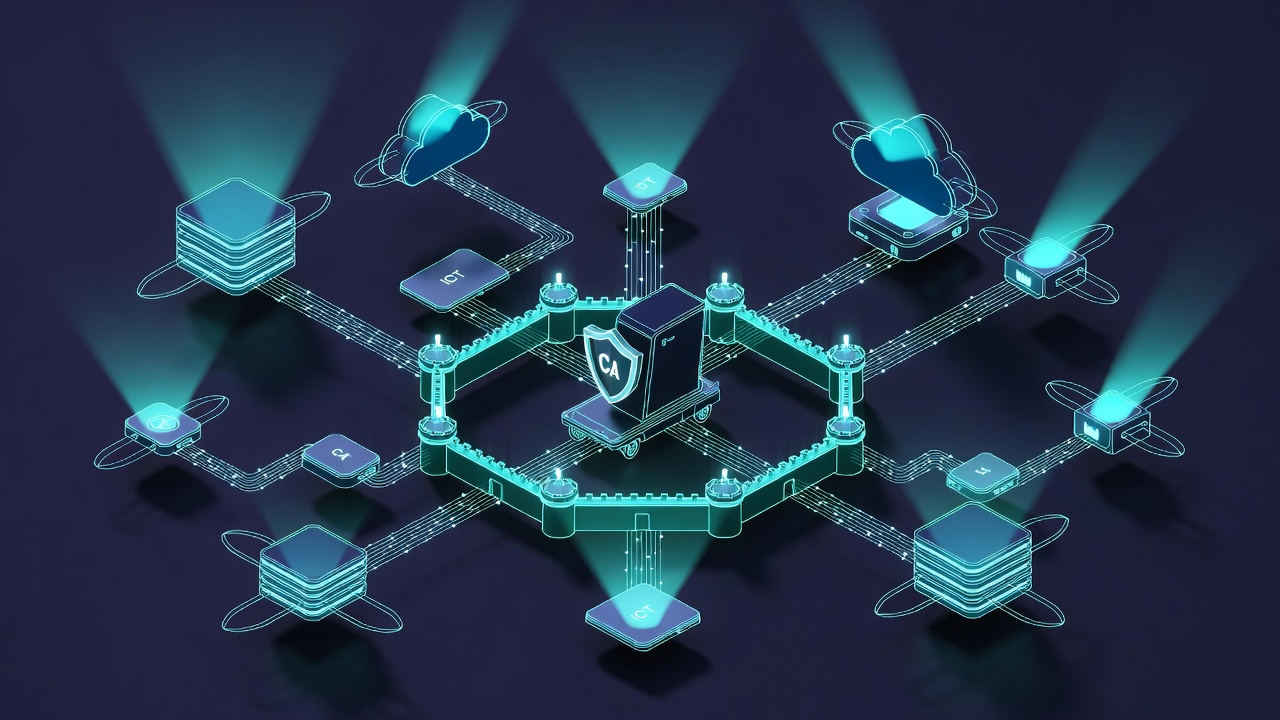
The architecture that avoids lock-in treats the cloud platform as a consumer of IoT device identity, not the source of it. In IEEE 802.1AR terms: you control the CA that issues IDevIDs and the infrastructure that manages LDevIDs. In Matter terms: you control the PAA/PAI hierarchy and the NOC issuance pipeline. The cloud platform simply trusts your certificates — it doesn't generate or own them.
Operate Your Own CA Infrastructure
Your root CA and issuing CAs run on infrastructure you control — either on-premises HSMs or a cloud-agnostic HSM service. IoT device identity certificates chain to your root, not to any platform's root.
For Matter compliance: This means operating your own PAA (with CSA approval and CPS audit) or purchasing PAI issuance from a CSA-approved PAA provider like DigiCert or Kudelski IoT. Your device attestation certificates chain to a trust anchor that isn't tied to any cloud provider.
For IEEE 802.1AR compliance: Your IDevID issuing CA provisions certificates during manufacturing that conform to the 802.1AR certificate profile. LDevID issuance is handled by your own intermediate CAs, which can be registered with multiple cloud platforms or on-premises backends simultaneously.
For operational certificates: Issue fabric-level or application-level certificates from your own intermediate CAs. The cloud platform trusts your root (registered as a custom CA in AWS IoT Core, Azure IoT Hub, or whatever platform you use), but the certificate authority itself is portable.
Trade-off: You bear the operational cost of running CA infrastructure — HSM maintenance, key ceremonies, CRL management, audit compliance. This is the same operational overhead that enterprise PKI teams manage, applied to device-scale volumes.
Abstract the Authentication Layer
Design your device firmware to authenticate against a standard protocol endpoint (MQTT with mutual TLS, for instance) rather than a platform-specific SDK. The authentication is certificate-based using standard X.509 validation. The endpoint URL is configurable, not hardcoded.
This lets you point devices at different cloud backends by updating a configuration parameter rather than replacing firmware. The IoT device identity certificate doesn't change — only the endpoint it authenticates against.
Trade-off: You lose platform-specific optimisations (AWS IoT device shadows, Azure Digital Twins) unless you implement them through a platform-agnostic abstraction layer. This adds development complexity but preserves operational flexibility.
Use Multi-Platform Certificate Registration
Register your IoT device identity certificates with multiple cloud platforms simultaneously. The same device certificate — issued by your own CA — is trusted by AWS IoT Core, Azure IoT Hub, and your on-premises backend. The device can authenticate against whichever platform serves it.
Trade-off: Managing certificate trust across multiple platforms adds operational complexity. Each platform has its own certificate registration process, quota limits, and policy enforcement. But it eliminates the single-platform dependency.
Building IoT Device Identity Infrastructure Before You Need It
Here's the parallel argument that product teams consistently underestimate: the cost of retrofitting device identity onto already-shipped products is 10–20x the cost of building it right during manufacturing.
Why Retrofitting Fails
You can't add hardware after shipping. If your first product generation uses software key storage and you decide hardware secure elements are necessary, every device already in consumers' homes is stuck with software keys. The IDevID — the manufacturer-provisioned identity — is fixed at production. There is no second chance.
Firmware updates have limited reach. Industry data consistently shows that 30–50% of IoT devices never receive firmware updates after initial deployment. Consumer devices are plugged in and forgotten. Industrial devices are in locked cabinets. Agricultural devices are in fields.
Re-provisioning requires connectivity. Rotating IoT device identity certificates on deployed devices requires each device to connect to your CA, authenticate with existing credentials, and receive new certificates. Devices with intermittent connectivity — the core IoT challenge — may take weeks or months to complete re-provisioning. Some never will.
Customer trust erosion. A firmware update that changes the device's identity infrastructure is visible to consumers as "your device needs to reconnect" or "please re-pair your device." Do this once and customers are mildly annoyed. Do it because you didn't plan your certificate architecture properly and then a security incident forces re-provisioning — that's a product recall in everything but name.
What "Building Before You Need It" Actually Means
Design IoT device identity architecture during product specification. The key storage decision, the CA hierarchy, the provisioning protocol, and the renewal mechanism should be specified in the product requirements document, not figured out during manufacturing ramp.
Integrate provisioning into manufacturing from day one. Even if your first production run is 10,000 units, build the provisioning infrastructure for 1 million. The marginal cost of building for scale at design time is a fraction of retrofitting later.
Choose your CA provider with decade-long commitment in mind. Your PAA provider or self-operated CA will need to support certificates for the lifetime of every device you ship. If your products have 10-year expected lifetimes, your CA provider relationship is a 10-year commitment.
Implement certificate telemetry from the first device. Don't wait until you have 100,000 devices to build monitoring. Start collecting authentication telemetry, certificate metadata, and device behaviour data from your first production batch.
Plan for post-quantum migration now. Devices shipping in 2026 with 10-year lifetimes will still be in the field in 2036. Post-quantum cryptography migration will be underway. If your device's IoT device identity certificates can't support algorithm rotation, you're shipping a product that will become cryptographically vulnerable during its supported lifetime.
The Axelspire Approach
We're currently building integration infrastructure for a Fortune 50 IoT platform — a deployment where the architectural decisions described above are playing out at million-device scale, with HSM-backed key management and manufacturing-integrated provisioning across multiple facilities.
Our approach to IoT device identity management follows the same thesis we apply to enterprise certificate management: understand the operational problem before choosing the tooling. Platform lock-in isn't a technology problem — it's an architectural decision that became irreversible. Manufacturing-stage identity provisioning isn't a manufacturing problem — it's a security architecture decision that was deferred too long.
If you're planning a connected product launch, evaluating Matter certification, or assessing CRA compliance requirements, we can help you design the IoT device identity architecture before the decisions become expensive to change. For the CTO-level view — regulatory timelines, TCO modelling, and build-vs-buy — see Device Identity Strategy. For the technical implementation of hardware-backed identity that avoids platform lock-in at the silicon level, see Hardware-Backed Device Identity. Talk to Axelspire about an IoT certificate assessment.
Related Axelspire Content
- IoT Certificate Management — Pillar overview
- Matter Device Attestation Certificates — PAA, PAI, and DAC hierarchy explained
- Hardware-Backed Device Identity — SE/TPM selection, vendor portability analysis
- Device Identity CTO Strategy — CRA/Cyber Trust Mark compliance, TCO, build vs buy
- Factory Provisioning — CM trust boundaries and provisioning model lock-in
- Keyfactor vs Venafi — Enterprise CLM vendor lock-in analysis
- Hardware vs Software Key Storage — The architectural decision that determines monitoring costs
- The IoT Certificate Lifecycle — Provisioning, renewal, and revocation at scale
- Post-Quantum TLS — Algorithm migration planning for long-lived devices
- HashiCorp Vault PKI — Platform-agnostic certificate issuance patterns